
The Internet of Things is one of the widest spoken about topics of tech innovation today. Five years ago, it was predicted that by 2020 26 billion items would belong to IoT. Instead, there are currently 31 billion items in existence today, with 127 new devices being installed every second being driven in part by pandemic innovation. That’s an average of around 4 smart objects for every human being in the world.
From your fitbit to your flight’s jet engine, the world is becoming more connected. Even plant pots now have feelings thanks to Lua, which detects 6 different reasons your plant may not be quite as happy as you’d like. In today’s London Tech Week panel talk, Yum Brands! Pizza Hut’s COO/CCO David Sturdee spoke about the role of tech in the developing restaurant world.
“You can do anything, you just can’t do everything.”
It’s about making your customers’ lives easier, whilst also making sure to enhance and not replace the human element. In partnership with Box Technologies, Pizza Hut used machine learning to optimise their delivery service. They’ve started to text and deploy AI production cameras, which can update you when your pizza is being made. Box Technologies also helped to roll out touch enabled devices, which ensured staff were able to manage multiple orders.
Just before Covid they were about to launch self-service in restaurants, but it has now come about far quicker and more widespread than anticipated. This shows how a pandemic can rapidly speed up the need for tech and increases the urgency to produce it quickly.
Most IoT smart devices aren’t in your home or in your phone. They are predominantly in factories, businesses and healthcare. Smart devices give these major industries the vital data they need to increase efficiency, save money and even save lives.
There are currently five types of IoT applications:
· Consumer IoT—light fixtures, home appliances, voice assistance for the elderly
· Commercial IoT— smart pacemakers, monitoring systems, vehicle to vehicle communication
· Industrial Internet of Things (IIoT)— digital control systems, statistical evaluation, smart agriculture, industrial big data
· Infrastructure IoT—enables the connectivity of smart cities through the use of infrastructure sensors, management systems and user-friendly user apps
· Military Things (IoMT)— robots for surveillance, human-wearable biometrics for combat
By 2025, the total global worth of IoT technology could be as much as $6.2 trillion. Most of that figure is made up from devices in healthcare $2.5 trillion and manufacturing $2.3 trillion.
So, what’s coming next?
Someday soon, robots will have the ability to learn from each other and work in teams to increase efficiency and problem solve. On a smaller scale, this already exists in the daily lives of some households with the likes of Roomba robot vacuum cleaners. IoT devices are also now able to collect data on the human body, with new research that tests our ability to control machines and potentially even one another with our minds. It’s anticipated that this new wireless chapter could bring about life-changing and life-saving changes.
How far off are we from controlling a computer with our minds as fast as we can control it with our hands?
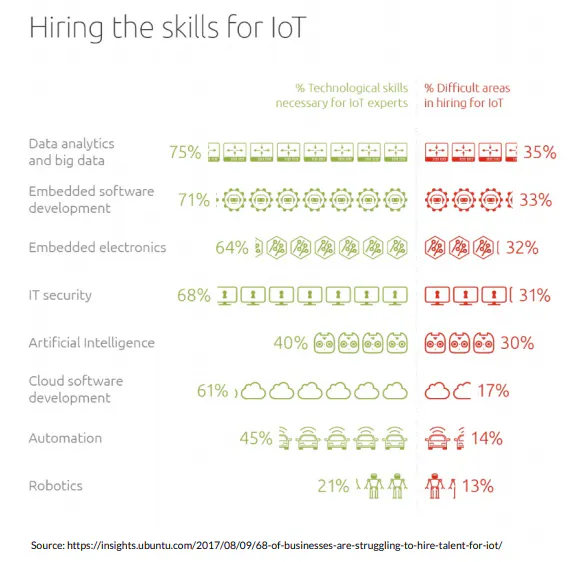
In terms of hiring, as the space continues to grow the need for experts in the area is vital to keep the momentum going. 35% of businesses surveyed said they look for professionals with knowledge of big data and analytics, with 75% identifying these skills as the most important for anyone claiming to be an IoT professional.
You can find out more about our current roles at www.osmii.com/jobs
https://www.indiegogo.com/projects/lua-the-smart-planter-with-feelings#/
https://securitytoday.com/Articles/2020/01/13/The-IoT-Rundown-for-2020.aspx?Page=2
https://mu-design.lu/lua#lua-2
https://informationmatters.net/wp-content/uploads/2017/09/UK-Internet-of-Things-Jobs-Outlook.pdf
https://informationmatters.net/wp-content/uploads/2017/09/UK-Internet-of-Things-Jobs-Outlook.pdf


